 .pdf
.pdf
Introduction
1. Description
According to the European Commission, roughly 75% of the EU building stock is energy inefficient and the building sector is responsible for around 40% of our energy consumption. Moreover, buildings generate 36% of the EU greenhouse gas emissions and studies such as showed that this is mainly due to energy use. Therefore, improving building energy efficiency is a major key to achieve the objectives set by the European Green Deal. Furthermore, indoor and outdoor thermal comfort and air quality highly impact people’s well-being, productivity and health. With climate change, these issues are becoming even more crucial and developing tools that can help building stock managers and decision makers understanding and controlling both indoor and outdoor comfort and air quality is essential.
The two-scale approach proposed in Ktirio Urban Building aims at offering simulation tools that can be used to predict energy consumption, thermal comfort and air quality at both the building and the urban scales. Analysis tools will be used to identify defects and abnormalities in the urban area and the buildings design and use. The analysis results could be used to set up efficient management, control and renovation strategies. At the urban scale, as the number of involved buildings can be important, simplified building energy and indoor air quality models will be used to simulate the contribution of the building stock, in terms of heat and GHG emissions, to the outdoor air quality model (UAP). When necessary (for instance: a building is identified as highly energy consuming or GHG emitting or if renovation works are planned), the building scale simulation, based on more refined models can be run to identify improvement keys. In both urban and building scale simulations, the integration of the building stock in its environment, thanks to the UAP model, will improve the boundary conditions of the building model. Indeed, the UAP model will provide more accurate outdoor conditions (temperature, wind speed and direction, etc.) to the building model. In addition, the radiative heat transfer on the buildings' envelopes will be improved through a better estimation of the solar shading.
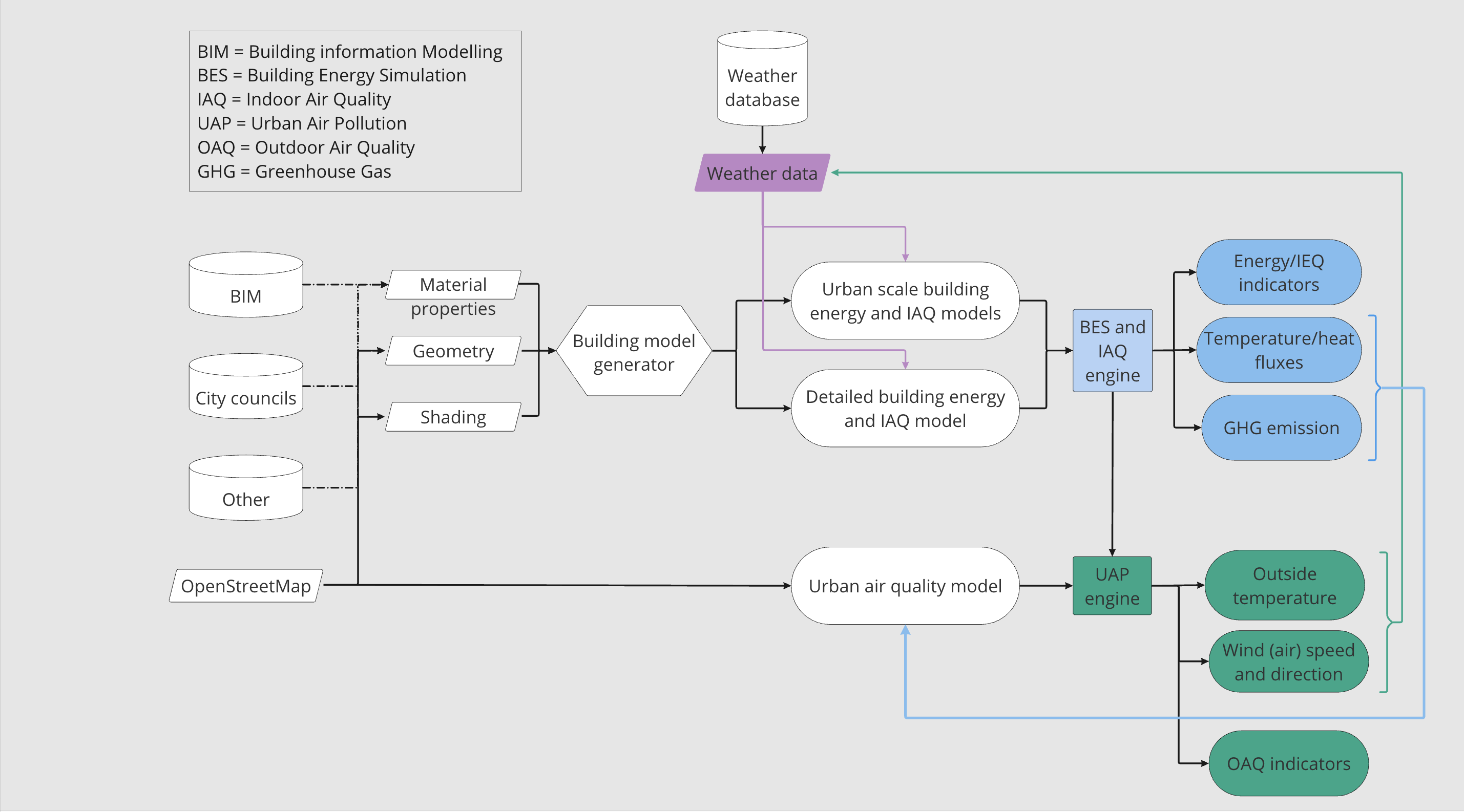
On the one hand, the BES engine simulates energy and indoor air quality of a single building (Detailed building) or a set of buildings (Urban scale buildings). The building models can be automatically generated (Building model generator) from a geometry file (BIM, OpenStreetMap (will be investigated), city councils or other). The material data can be embedded in the geometry file or inserted in an additional step. UB outputs heat and air pollutants that are inputs of the UAP model. On the other hand, UAP will provide more accurate outdoor conditions (weather data) to UB. In addition, the radiative heat transfer of the building models will be improved due to a better estimation of the solar shading through the integration of the buildings in their environment thanks to the UAP model.
- Overall aim for ktirio
-
the contribution to the UAP model consists in providing building energy and indoor air quality models to simulate the contribution of the buildings at the city scale, in terms of heat, GHG and NOx emissions. In return, the UAP model will provide more accurate outdoor conditions (temperature, wind speed and direction) to the building model. In addition, the radiative heat transfer on the buildings' envelope will be improved through a better estimation of the solar shading.
- Main Algorithms and Tools
-
Algorithms and numerical methods in order to carry out research for UB pilot: Multizone models, CFD, heat transfer, passive transport Model order reduction: reduced basis and non-intrusive reduced basis, data assimilation, HPC multiprocessing libraries. The following tools are used for model generation: Dymola (Modelica language), fmpy (python), Salome, GMSH, FMI standard. Simulation process is conducted by the following frameworks: Feel++ (zenodo doi: 10.5281/zenodo.5718297), PETSc, Execution support for fmu in co-simulation mode.
- Data
-
Input data required by UB applications: Geometric representation of buildings (BIM in ifc format. If the BIM model is not available, it can be reconstructed from a 3D scan), Material properties (BIM, expert, thermographic study, estimates based on the building knowledge, etc.), Use/occupation scenarios, energy systems schedule if applies, Weather files, Energy consumption of the building (detailed bill, kwh), Type of heating system (heat pump[air air, air water, water-water], electricity boiler, gas boiler or fuel boiler -), Type of energy(electric, gas, fuel) of the energy systems, Sensor data (deployed, heat, humidity, air quality, energy consumption, etc.).
- UB produces the following data
-
heat flux on surfaces, temperature on surfaces, GHG emission: air pollution exhausts (average quantity of interest per building, CO2, NOX 40% produced by traffic and other part by buildings and companies in summertime, NOX from traffic increases), implement NOX emission from buildings during the project.